Education Business 27.6
With five education secretaries in four months and a changing ministerial line up, the Department for Education has experienced upheaval since September. But it seems to have settled now, with the ministerial line-up confirmed by prime minister Rishi Sunak.
Gillian Keegan is now the education secretary, and the DfE sees some old faces return, such as Nick Gibb and Robert Halfon. Read our summary of who’s who in the new-look Department for Education, as well as Rishi Sunak’s likely direction for education, on page 15.
With the energy and cost of living crisis upon us, Suzanne Gibbon from the Let’s Go Zero campaign shares everyday energy saving measures for schools, and explains how the campaign is lobbying for the government to support schools in their net-zero ambitions, on page 19.
We also look at the impressive Glebe Farm School – a fossil‑free new build school in Milton Keynes. It’s so ‘green’ that it’s been removed from the grid and even its Bunsen burners are powered without gas. The school’s headteacher, Matthew Shotton, explains the project on page 23.
Education Business 2705
Heatwaves and the school environment
The UK’s heatwave earlier this summer disrupted the end of term, with some schools finishing early, cancelling events or moving to online learning.
The extreme heat brought into sharp focus both the issue of climate change, and the importance of having a healthy indoor environment for pupils and staff in schools.
The Building Engineering Services Association (BESA) tackles the subject on page 49, looking at links between air quality, temperature and Covid-safety controls within school buildings.
The government’s sustainability and climate change strategy for education says that not only will all new DfE-delivered school buildings be net zero in operation, they will be designed for a 2oC rise in average global temperatures and future-proofed for a 4oC rise. This is so they are resilient to the risks of climate change, including increased flooding and higher indoor temperatures.
Richard Hipkiss, development director of the Modular and Portable Building Association (MPBA), takes on the subject of greener school buildings on page 40, and makes a case for volumetric manufactured buildings in shaping a net zero future.
Angela Pisanu, editor

Education Business 2704
Influencing the education landscape
This issue of Education Business includes our second EB50 Most Influential list, which is our pick of the fifty individuals making an impact on education.
With changes on the horizon outlined in the Schools White Paper, our EB50 Most Influential list looks at the individuals that have, or are having, an influence on the education landscape. This may be through classroom practice, curriculum delivery, assessment, governance, funding, safeguarding, policy reform, teacher training, business management, and so on.
Continuing the topic of inspiring individuals and teams in education, the winners of the Education Business Awards 2022 are revealed on page 52. Winners were recognised under 18 categories, spanning environmental excellence, ICT facilities and SEN provision, as well as outstanding progress.
Elsewhere, Lisa Fathers from the Bright Futures Educational Trust writes on the best methods to boost recruitment and retention in schools, while Emma Hollis from the National Association of School-Based Teacher Trainers, explores the Initial Teacher Training landscape. On page 47, Sarah Lyons from the National Cyber Security Centre shares advice on how schools can protect themselves from cyber threats, and Dr Fiona Aubrey-Smith gives tips on using evidence effectively when making decisions about education technology, on page 37.
Angela Pisanu, editor

Education Business 27.03
Making education planet-friendly
The Department for Education has launched its Sustainability and Climate Change Strategy, which includes plans to improve the teaching of climate issues and the natural world, take action to reduce emissions from education buildings, as well as improve biodiversity on school land.
The government recognises that the education of future generations will be crucial to securing the health of the planet. It will therefore introduce a new Natural History qualification by 2025, which will teach environmental and sustainability issues, and has pledged greater support for teaching climate change at all levels.
The strategy also outlines plans to reduce direct and indirect emissions from education buildings, as well as make the education estate resilient to the effects of climate change.
This issue of Education Business delves into the DfE’s climate strategy, on page 25, while on page 19, Angela Howarth from the Energy Saving Trust shares tips on how to become more energy efficient amid rising energy prices and environmental concerns.
Elsewhere, Victoria Temple from the National Centre for Computing Education explains how schools can ‘grow’ their own computing talent by getting teachers of other subjects to do bursary-funded computing training.
Angela Pisanu, editor
Education Business 27.02
Learning to live with Covid
The government’s ‘Living with Covid’ plan has changed how schools operate in the pandemic. Staff and pupils in mainstream secondary schools no longer need to conduct regular asymptomatic testing, and while those testing positive are still advised to stay at home, after 1 April, they will be asked to exercise personal responsibility.
A DfE blog says that the best measures to prevent the spread of Covid-19 in education settings are “good ventilation, hygiene and encouraging vaccination uptake, as well as following any additional advice from local directors of public health”.
This issue of Education Business examines how ensuring good air quality inside schools can help manage the Covid spread, and what support is available for schools to put in place ventilation and air purification technology.
As schools continue to help pupils recover from the pandemic – academically, physically and mentally, the Youth Sport Trust looks at how to rebuild activity levels in children, while Lord Jim Knight, a former minister for schools, digital and employment, investigates how education technology can help from both an academic and wellbeing perspective.
Angela Pisanu, editor
Education Business 27.01
Protecting face-to-face education
During the current surge in Omicron cases, the education secretary Nadhim Zahawi has appealed to school leaders to do everything in their power to protect face-to-face learning and keep schools open.
Acknowledging that operational challenges could be caused by workforce shortages, an open letter by Zahawi encourages schools to consider implementing a flexible approach to learning, and is urging retired teachers and those that have left the profession to come back to the classroom.
Keeping schools well ventilated to reduce the spread of the virus has become a major focus in schools. As the virus is mainly transmitted by air, keeping spaces well ventilated can dilute the virus, while air cleaning technology is also being investigated. Read the latest on ventilation and air purification on page 23.
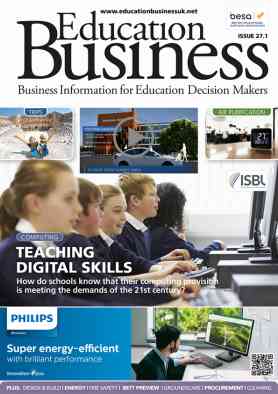
Digital skills are increasingly important for young people’s future, but how do schools know that their provision is meeting the evolving demands of the 21st century? Page 53 shares how schools can develop their computing provision with a new evaluation tool from the National Centre for Computing Education, called the Computing Quality Framework (CQF).
Angela Pisanu, editor
Education Business 26.06
Clean air in the classroom
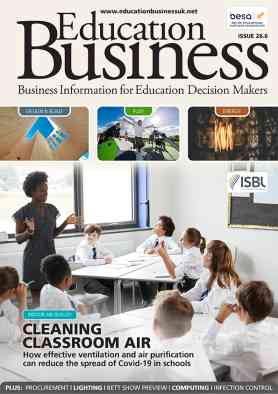
With the knowledge that Covid-19 mainly transmits via airborne particles, the pandemic has brought the issue of indoor air quality into sharper focus.
Improving ventilation is one of the safety measures that schools have been asked to do, and now the Department for Education is in the process of supplying schools with CO2 monitors to identify where ventilation needs to be improved. While this move has been received well, unions are calling for funding to actually invest in solutions to improve ventilation and clean the air.
The issue of air quality – indoor and out – is nothing new. There are numerous harmful pollutants and infectious diseases that are carried through the air, and using effective ventilation and air purification can help combat them to create a healthy and more pleasant school environment.
This issue of Education Business looks at the topic of indoor air quality, asking our Panel of Experts on page 22 what they recommend schools do to keep spaces well ventilated with air clean.
With COP26 ongoing at the time of writing, the issue of sustainability is tackled by Alex Green from the Let’s Go Zero campaign, which brings together UK schools aiming to become zero carbon by 2030. Find out more about the initiative, as well as practical ways to go green, on page 33.
Angela Pisanu, editor
Education Business 26.05
Back to school with relaxed Covid rules
Schools have welcomed pupils back for the Autumn term with less Covid restrictions.
The ‘bubble’ system has ended and close contacts of positive covid cases no longer have to self isolate for ten days, instead taking a PCR test and isolating if positive. But the pandemic is still ongoing, and disruption to education is expected. Indeed, the government has reintroduced its remote education direction, which places a legal duty upon schools to provide immediate remote learning for pupils unable to attend classes due to Covid-19.
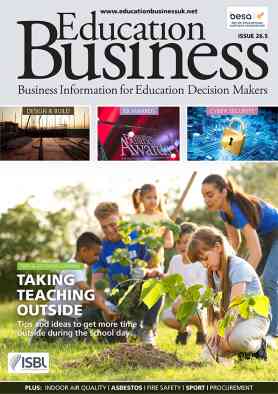
This issue of Education Business magazine explains the infection control measures that are continuing in schools despite a relaxation of rules, such as extra hygiene measures and enhanced cleaning. Indoor air quality is also discussed, including the role of ventilation, fresh air and air purification in eradicating virus particles in circulation. And with less chance of catching the virus outside, the Council for Learning Outside the Classroom gives tips and advice on how schools can increase the amount of time they spend outside during the school day.
Elsewhere in the magazine, we give an update on the government’s School Rebuilding Programme, looking at some of the newly confirmed schools, as well as the building projects selected during the first wave of funding. Meanwhile, John McClean from the Joint Union Asbestos Campaign discusses the dangers of asbestos and what needs to happen to tackle the invisible killer.
Angela Pisanu, editor

Education Business 26.04
Fifty inspiring people
This issue of Education Business has our first EB50 Most Influential list – our pick of the people that have made an impact on the education system in England.
It includes government officials, head teachers, heads of MATs, charities, union representatives, lobbyists and so on. They are committed individuals that have played their part in bettering the experiences and outcomes of children and young people in education, as well as for those working in the profession. Read the list on page 41.
The education sector is continuing to navigate the pandemic, with things still up in the air about how schools will function at the start of the next academic year. With Coronavirus very much still around, schools still have to ensure they can provide remote education to those self isolating - although there is talk that quarantining bubbles due to a positive case may end in the autumn. On page 55 Stephanie Glenister from The Key explains how schools across the country are nailing the blended learning approach.
With changes to fire safety design for schools being consulted on, pages 23 and 29 look at what has changed in the guidance, particularly around sprinklers and safe cladding - and asks whether the guidance goes far enough to adequately protect schools.
The Education Business Awards take place on 8 July live online. Hosted by Jeff Brazier, the awards continue to celebrate excellence within the sector. Find out who’s been shortlisted on page 37.
Angela Pisanu, editor
Education Business 26.03
Playing catch-up
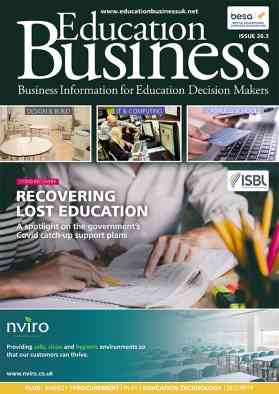
A study by the Education Endowment Foundation has found that the attainment gap between disadvantaged primary school pupils and their classmates in maths has grown by one month since the onset of the pandemic.
The study also shows that the attainment gap did not widen or shrink during the Autumn 2020 term when schools were open, suggesting that gaps caused by Covid are unlikely to close without intervention.
The government has outlined what it believes this intervention should be, and has acknowledged that catch-up measures need to focus on long-term recovery, as well as the here and now. Tutoring, summer schools, and free teaching resources make up part of the plan, and Sir Kevan Collins has been appointed as Education Recovery Commissioner to oversee the education catch-up programme, and take a longer term view.
Staying on the theme of long-term education recovery, a new study, called COVID Social Mobility and Opportunities (COSMO), will follow the outcomes of year 11 students across England to find out how the pandemic has affected them in terms of educational attainment, wellbeing, longer-term educational and career outcomes, and socio-economic inequalities in life chances.
Page 15 of this issue of Education Business takes an in-depth look at the government’s catch-up support plan, while page 47 focuses on how education technology can help pupils recover lost learning. Page 60 meanwhile outlines how play can reduce the negative impact school closures had on pupils, and how it should not be sacrificed due to pressure to increase classroom time.
Angela Pisanu, editor