

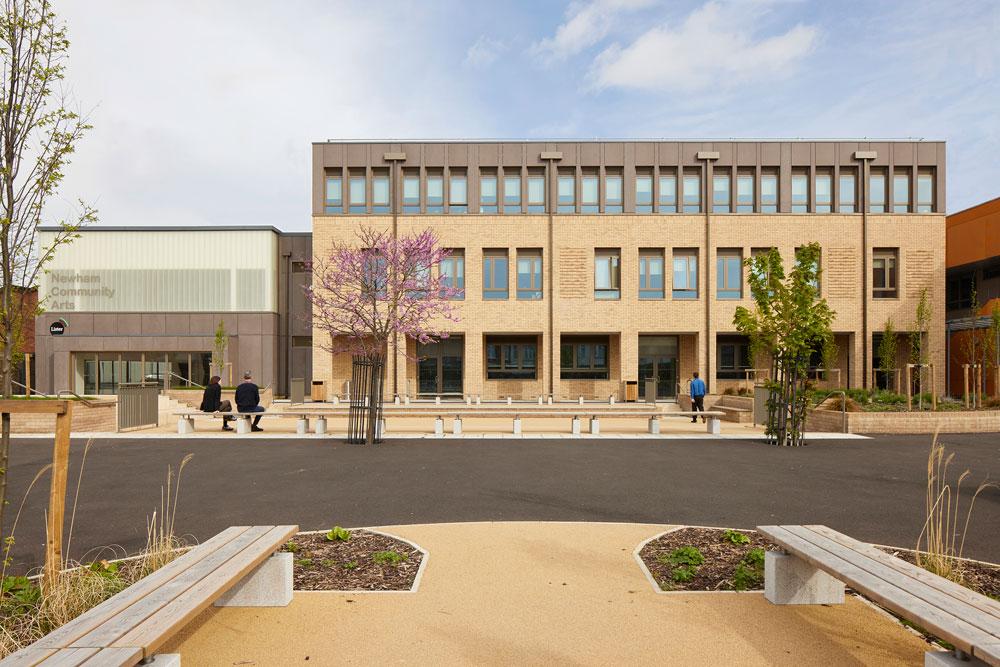
Image shows Lister Community School, credit McAvoy Group.
With education estates under pressure to cut carbon while still delivering inspiring, affordable learning spaces, the way schools are built has never mattered more. Jackie Maginnis, chief executive of the Modular and Portable Building Association, outlines how the MPBA’s new Roadmap to Net Zero is providing a clear, practical framework to help the sector embrace low-carbon, modular solutions
The UK education sector faces mounting pressure to create learning environments that both inspire students and align with ambitious climate and carbon reduction targets. Schools, colleges and universities are being urged to rethink how they design, construct and manage their estates – embracing energy efficient, low carbon solutions, sustainable materials and modern methods of construction such as modular technology to cut waste and emissions.
This shift demands more than incremental change. It requires a strategic rethinking of the entire building process – from developing climate action plans and setting measurable sustainability targets to partnering with contractors who can deliver genuinely sustainable outcomes.
Recognising the urgent need for decisive leadership and a unified vision, the Modular and Portable Building Association (MPBA) has launched a landmark initiative – a clear, evidence-based roadmap to guide the sector toward a truly sustainable, low carbon future. So what are the driving forces and critical importance behind the MPBA’s Roadmap to Net Zero?
A three pillar approach
From early years settings to universities – modular and offsite construction already play a vital role in providing rapid, cost-effective solutions to meet growing demand for educational spaces. The MPBA’s Roadmap to Net Zero builds upon this foundation, offering a clear and practical framework to help the sector and its education partners contribute meaningfully to net zero targets.
In 2024, the MPBA and our members established a dedicated Sustainability Committee to lead the industry’s collective journey to net zero. The Committee’s work is guided by three core pillars – understanding, assessing and implementing – which together provide the foundation for lasting change.
Understanding the needs of the sector and the challenges facing organisations across the modular and portable building supply chain involves identifying the specific barriers and opportunities that exist in education related construction, from temporary classrooms to large scale campus expansions.
The second pillar involves assessing current progress and performance, both collectively and within individual member organisations. By establishing consistent benchmarks and data-driven insights, the Committee aims to create a clear picture of where the industry currently stands on sustainability and what steps are needed to move forward.
The final pillar involves implementing a comprehensive plan to accelerate sustainability across all aspects of design, manufacture, transport and the installation operation. This involves creating practical guidance, tools and measurable milestones to help our members and their education clients take meaningful action. This structured approach ensures that sustainability is not treated as an add-on or marketing claim, but as a fundamental part of how modular buildings are conceived, delivered and maintained.
Whole life carbon and the education estate
Central to the MPBA’s strategy is a commitment to tackling whole life carbon – an area of growing focus across the education sector. Whole life carbon considers the total greenhouse gas emissions associated with a building throughout its entire lifespan.
From the extraction and manufacture of materials right through construction and operation, to end-of-life processes such as deconstruction or reuse.
By embedding this into design, specification and manufacturing processes, MPBA members will support schools, colleges and universities to move beyond simply reducing operational emissions (such as heating and electricity) towards understanding and minimising embodied carbon – the emissions locked into building materials and construction processes.
For the education sector, this shift offers both environmental and practical benefits. Modular buildings are inherently more resource efficient than traditional builds. Factory controlled manufacturing allows for precision in material use, reduction in waste and improved quality control. Whilst the ability to disassemble and relocate buildings supports the principles of a circular economy. These qualities make modular construction a natural ally for education providers seeking sustainable and adaptable infrastructures.
Evidence of sector wide commitment
To better understand current practices and priorities, we conducted a sustainability survey among our members. The results reveal a sector that is not only aware of its environmental responsibilities but is actively taking steps to meet them.
Over 80 per cent of respondents identified sustainability and net zero as major drivers of their business strategy. Nearly 50 per cent have already carried out Life Cycle Assessments (LCA) or Embodied Carbon Assessments, demonstrating a sophisticated level of understanding of their buildings’ environmental impacts.
These findings highlight a strong alignment between the MPBA’s goals and the values of our members – many of whom are already supporting education clients in delivering low-carbon buildings that meet stringent energy and environmental performance standards.
Supporting the education sector’s net zero ambitions
Education institutions across the UK are setting ambitious sustainability targets. From the Department for Education’s Sustainability and Climate Change Strategy to local authority net zero action plans, there is growing recognition that education estates must play a key role in achieving net zero target.
Our Roadmap to Net Zero directly supports these ambitions. By aligning modular building standards with government frameworks and sustainability benchmarks, our association is helping to ensure that modular construction continues to meet the evolving needs of the education sector –delivering buildings that are energy efficient, affordable and adaptable to future demands.
Leadership, collaboration and advocacy
By developing sector-specific guidance, tools and benchmarks – the MPBA helps standardise how organisations measure and reduce carbon across the building lifecycle.
Through events, training and case studies, the MPBA promotes practical examples of how modular buildings can support sustainable education – from zero-carbon classrooms to circular design approaches that extend building life.
Introducing the MPBA Net Zero Charter
Building on the work of the Sustainability Committee, the MPBA is preparing to launch a Net Zero Charter for our members. This initiative will set out clear commitments, milestones, and responsibilities – providing a robust framework for action and transparency.
For education clients, the Charter offers reassurance that suppliers are not only aligned with the UK’s sustainability goals but are actively measuring and reporting their progress. Members who sign up to the Charter will be able to display a visible mark of credibility, reinforcing trust and accountability across the supply chain.
Towards a greener learning environment
Our Roadmap to Net Zero represents more than an industry plan – it is a shared vision for a sustainable, resilient, and forward-thinking built environment. For the UK education sector, it offers a clear route to decarbonisation, backed by research, collaboration and practical guidance.
By combining modular construction’s proven efficiency with a rigorous approach to whole life carbon, the MPBA is empowering schools, colleges, and universities to make confident, sustainable choices – creating modern learning spaces that are better for people, budgets, and the planet.
Join forces for greater impact
As part of a dynamic community, the Modular and Portable Building Association provides an environment where like-minded professionals collaborate, share ideas and forge meaningful connections that drive innovation and growth. As the construction industry continues its shift towards net zero – the MPBA remains the industry’s leading body for ensuring members are positioned for success.