

From record-breaking heat and prolonged drought to flash flooding and deep freezes, increasingly volatile weather is impacting the maintenance procedures and schedules of outdoor sports surfaces. The view of the Sports and Play Construction Association (SAPCA) is that, whether you are looking after natural grass, a 3G pitch or a short-pile hockey surface, the key is to manage according to conditions rather than the calendar
If grounds management teams and other professionals and volunteers responsible for sports pitches needed a reminder that extreme heat is becoming a serious operational issue, summer 2026 provided it. The Met Office declared it provisionally the UK’s warmest summer on record, with a mean temperature of 16.5°C across June, July and August. Temperatures reached 38°C during heatwaves in both June and August, while prolonged dry weather contributed to drought conditions across parts of England and Wales. And just as the heat waves seems to be over, the UN has warned that we need to brace for a “super-sized el Niño”.
The thing is that 2026 is unlikely to be simply an exceptional year to be endured before normal service resumes. UK climate projections point towards hotter, drier summers and warmer, wetter winters, alongside an increasing likelihood of weather extremes.
Heavy summer rainfall, when it comes, is also expected to become more intense. For those responsible for sports pitches, this will mean preparing for both ends of the spectrum.
Natural grass: protect the plant
Natural turf is arguably the surface most visibly affected by extreme heat. During prolonged dry conditions, moisture loss places the grass plant under stress, growth slows and ultimately stops, while the soil profile can become increasingly hard. The temptation can be to respond by doing more. In reality, good drought management often means doing less.
SAPCA recommends increasing the height of cut during drought, mowing during cooler parts of the day and avoiding mowing altogether where grass has become dormant. Fertiliser, herbicide and aggressive operations such as scarifying should also be avoided when the plant is already under severe stress.
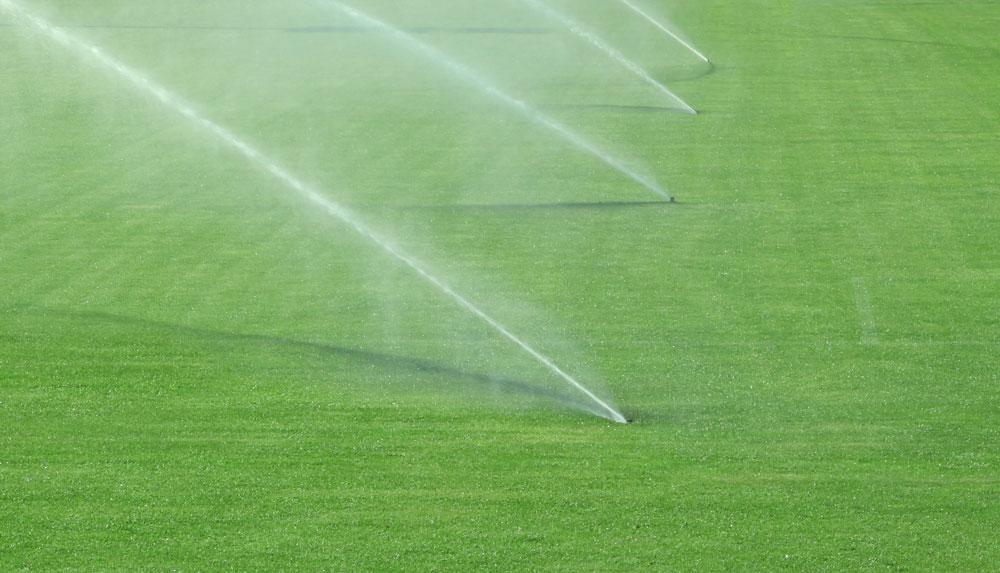
Irrigation, where available and permitted, needs to become more strategic rather than simply more frequent. Watering during the hottest part of the day increases losses through evapotranspiration, making overnight, early-morning or evening applications more efficient. Particular attention can be given to vulnerable and heavily used areas such as goalmouths and centre circles rather than automatically treating an entire site equally.
Grounds teams also need to monitor what is happening below the colour of the grass. A brown pitch is not automatically a failed pitch: many grasses can enter dormancy and recover once moisture returns. Surface hardness, rootzone moisture and the ability of the surface to provide safe traction are more important indicators of whether play should continue.
That makes testing and observation increasingly important. Continued intensive use of a very hard, drought-stressed surface can damage the turf and create player-safety concerns even when the pitch appears superficially flat.
Recovery should also be planned before rain arrives. The GMA’s drought guidance encourages facilities to have seed, materials, contractors and budgets ready so renovation can begin when moisture and temperatures become favourable again.
Longer term, drought resilience could include better irrigation control, rainwater harvesting and storage, improved soil management and choosing grass species and cultivars suited to the site’s conditions. The objective is not necessarily to keep every pitch emerald green throughout a heatwave, but to maintain a healthy plant and a safe surface using water responsibly.
3G: artificial does not mean unaffected
The challenges are slightly different for 3G synthetic turf pitches. There is no living plant to protect from drought, but high temperatures can still have significant implications.
Artificial turf absorbs the sun’s energy and surface temperatures can become considerably hotter than the surrounding air. FIFA’s stadium guidance acknowledges that artificial pitches may require irrigation in warm climates, specifically to cool the carpet, as well as for cleaning and presentation. Therefore, as the UK’s climate heats up, the guidelines are applicable here too. Watering, where practicable and appropriate to the system, can slow the development of heat on an artificial surface.
That should not, however, be interpreted as an instruction to simply put sprinklers on every 3G field during a heatwave. Pitch construction, carpet, infill, drainage and shockpad systems differ, and the manufacturer’s maintenance instructions should remain the starting point.
Operational decisions are just as important. Where conditions are exceptionally hot, facilities might want to consider moving maintenance and, where practical, activity towards cooler parts of the day. Surface temperature and player welfare should form part of the decision-making process rather than relying solely on air temperature.
Routine maintenance also remains essential. An infil 3G pitch relies on the correct quantity and distribution of infill to provide its intended performance characteristics. Brushing helps keep fibres upright and redistribute displaced material, while periodic checks should identify areas where infill levels, compaction or wear are becoming inconsistent. Checking infill depth and surface characteristics as part of the regular maintenance cycle is advised, alongside inspecting seams and removing debris.
In short, extreme weather does not remove the requirement for routine maintenance; it makes understanding the condition of the surface more important.
Hockey surfaces: managing heat and water
Short-pile or 2G, non-infill synthetic pitches used for hockey create another set of challenges.
Many high-level hockey surfaces have traditionally been irrigated immediately before play to create the fast, consistent playing characteristics required by the sport. Hot, sunny conditions can accelerate evaporation, potentially changing how the surface performs between watering and play.
Hockey’s world governing body, FIH, stipulates that irrigation should match the requirements of the particular hockey turf installed. More water is not automatically better: excessive watering can itself adversely affect playing performance.
Water management therefore becomes particularly important during periods of drought or water-use restrictions. Systems should distribute water evenly and efficiently, with maintenance teams checking sprinklers, pumps and controls rather than compensating for poor distribution simply by increasing volumes.
Hockey is already moving towards surfaces requiring less water. FIH has been working with manufacturers to develop non-irrigated “dry turf” systems, recognising that routinely watering an entire sports field is increasingly difficult to justify environmentally and economically. The topic of “dry” hockey pitches has been discussed at length at previous SAPCA events.
For existing non-filled, sand-dressed and other short-pile systems, maintenance should again follow the manufacturer’s regime. The FIH stresses that there is no such thing as a maintenance-free synthetic surface: cleaning, grooming, checking joints and managing contamination remain necessary if performance and life expectancy are to be maintained.
When drought turns to flood
Perhaps the most difficult challenge is that extreme heat and drought do not preclude extreme rainfall. A hard, dry summer can be followed by intense downpours, while climate projections suggest that heavy rainfall events will become an increasingly important consideration for UK sport.
For natural pitches, the first rule following flooding is not to rush the surface back into use. Saturated soils are vulnerable to compaction and structural damage, and standing water may also contain sediment, sewage or other contaminants. Once water has receded, drainage systems, surface levels and grass condition need inspecting. Sediment may need removing, depressions repairing and areas where grass has died renovating and reseeding.
Artificial pitches present different risks. Significant flooding can lift and move artificial grass carpets, while sediment and contamination may require specialist cleaning. Infill can also be displaced or washed from an infilled system. Following a serious flood, professional assessment may therefore be necessary before the facility is reopened.
For facilities with a known flood risk, resilience begins long before the rain arrives. Sport England recommends flood planning that considers buildings, machinery and pitches, including how facilities will respond to flood warnings and recover afterwards.
The other extreme
Extreme cold may become less frequent overall as the climate warms, but that does not mean frost, snow and freeze-thaw cycles will disappear. On natural turf, SAPCA advises keeping both players and machinery off frost-covered grass. Traffic on frozen leaves can damage plant tissue, while a surface that appears to have thawed can remain frozen below, creating both turf-damage and player-safety issues. Salt, hot water and snow-melting chemicals should not be used on natural turf.
Synthetic surfaces require their own precautions. SAPCA guidance notes that snow and ice themselves do not normally damage synthetic turf and can generally be allowed to melt naturally. Where snow removal is essential, appropriate brushes or non-metallic equipment should be used rather than metal scrapers.
More importantly, a frozen artificial pitch should not automatically be assumed to be safe simply because it remains visually playable. Synthetic fibres become relatively brittle at low temperatures and that shock absorption can be significantly reduced. Playability therefore needs to be judged according to surface condition and player safety.
Maintaining resilience
The common thread across every surface and every weather extreme is preparation. Maintenance programmes can no longer simply follow a fixed annual timetable irrespective of conditions. Grounds teams need weather information, good records, regular surface inspections and enough flexibility to postpone an operation when carrying it out would cause more harm than good.
Facilities can also build resilience into future investment: effective drainage to cope with intense rainfall; efficient irrigation and water harvesting for prolonged dry periods; suitable turf and infill systems for the local climate; and maintenance equipment capable of keeping those surfaces within their intended performance parameters.
A well-designed 3G pitch, hockey surface or natural grass field will always be more resilient than a poorly designed one. But construction alone is not enough.
As Britain’s weather becomes more volatile, the surfaces that cope best will be those whose operators understand when to intervene – and, just as importantly, when to leave the pitch alone.
For more information on how to properly maintain synthetic turf pitches, visit the SAPCA website, where you can download the SAPCA Code of Practice for The Maintenance of Synthetic Surfaces. There are also other Codes of Practice which offer a wide range of guidance for pitch maintenance, construction and resurfacing.